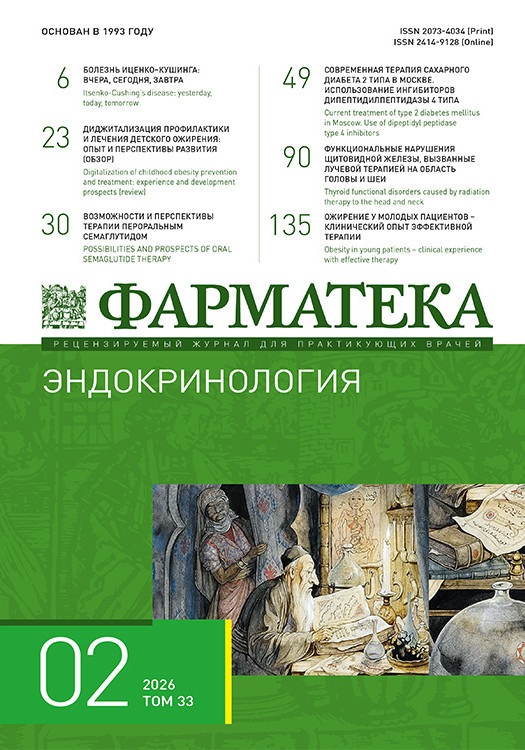
Current treatment of type 2 diabetes mellitus in Moscow. Use of dipeptidyl peptidase type 4 inhibitors
Demidov N.A., Kosova E.A., Antsiferov M.B.
Background: The pathogenetic variability of type 2 diabetes mellitus (DM2) necessitates the use of a wide range of glucose lowering drugs (GLDs) that affect various disease mechanisms and enable the development of individualized treatment strategies by selecting different classes. To evaluate current strategies in real-world clinical practice, an analysis of the structure of DM2 therapy was conducted in a cohort of Moscow patients.
Objective: Examination of the current treatment regimen for DM2 in Moscow using data from the Moscow segment of the Clinical and Epidemiological Monitoring Database for Diabetes and the role of dipeptidyl peptidase type 4 (DPP-4) inhibitors in its treatment.
Materials and methods: A retrospective analysis of data from 355,210 diabetic patients treated in outpatient medical facilities of the Moscow healthcare system as of March 10, 2026, was conducted. Particular attention was paid to the role of DPP-4 inhibitors, in particular vildagliptin, in DM2 therapy, especially in older patients.
Results: The analysis included 355,210 patients with DM2, including 224,018 (63.1%) women. The mean patient age was 69.1±11.1 years, and the mean diabetes duration was 9.3±7.4 years. The most frequently used treatments were monotherapy [36.7% (130,236 patients)] and dual combination therapy [29.8% (105,949 patients)]. Less frequently, therapy with 3 or more GLDs was used [12.4% (43,926 patients)]. Insulin therapy was used in 19.8% of cases (70,390 patients). 1.3% of patients (4,709 people) were on diet therapy. In the structure of DM2 therapy, the most frequently prescribed drug was metformin - 77.7% (276,072 people) and sulfonylurea (SU) drugs [38.8% (137,877 people)]. DPP-4 inhibitors were used in 27.4% of cases, while in 40.5% of cases they were represented by vildagliptin. GLP-1 agonists were used in 4.8% of patients.
Conclusion: The majority of patients are elderly and senile (65+ years), with a high prevalence of comorbidities. DPP-4 inhibitors are used by 27.4% of patients, of which 40.5% use vildagliptin, indicating its clinical efficacy and safety. Vildagliptin appears to be a natural choice for a wide range of patients with type 2 diabetes mellitus, particularly in the elderly, due to its favorable safety and efficacy profile.
For citations: Demidov N.A., Kosova E.A., Antsiferov M.B. Current treatment of type 2 diabetes mellitus in Moscow. Use of dipeptidyl peptidase type 4 inhibitors. Pharmateca. 2026;33(2):49-55. (In Russ.). DOI: https://dx.doi.org/10.18565/pharmateca.2026.2.49-55
Authors’ contribution: M.B. Antsiferov – scientific supervision of the project, formulation of the idea, hypothesis, and research objective; development of methods, editing, and finalizing the text. E.A. Kosova – verification of results, statistical or theoretical analysis of data, editing, and finalizing the text. N.A. Demidov – data collection; processing, preparation for statistical analysis, and writing the initial text of the article.
Conflicts of interest: The authors confirm that they have no conflicts of interest to declare.
Funding: The study was conducted without any sponsorship.
Patient Consent for Publication: The retrospective design of the study did not require informed consent from patients for statistical processing of anonymized data for subsequent publication.
Authors’ Data Sharing Statement: The data supporting the findings of this study are available upon request from the corresponding author after approval from the principal investigator.
Keywords
type 2 diabetes mellitus
DPP-4 inhibitors
vildagliptin
elderly
ASCVD
CKD
CHF
About the Authors
Nikolay A. Demidov, Cand. Sci. (Med.), Endocrinologist, Moscow Multidisciplinary Clinical Center “Kommunarka” of the Moscow Healthcare Department; Associate Professor of the Department of Endocrinology, Institute of Clinical Medicine, Pirogov Russian National Research Medical University, Moscow, Russia; Nicolay13@mail.ru, ORCID: https://orcid.org/0000-0001-8289-0032, eLibrary SPIN: 7715-4508 (corresponding author)Elena A. Kosova, obstetrician-gynecologist, Head of the Antenatal Clinic, Moscow Multidisciplinary Clinical Center “Kommunarka” of the Moscow Healthcare Department, Moscow, Russia; akusherkuznechiki@bk.ru
Mikhail B. Antsiferov, Dr. Sci. (Med.), Professor, President, Endocrinology Dispensary, Moscow Healthcare Department; Professor, Department of Endocrinology, Russian Medical Academy of Continuous Professional Education, Moscow, Russia; antsiferov@rambler.ru, ORCID: https://orcid.org/0000-0002-9944-2997, eLibrary SPIN: 1035-4773
Similar Articles